Case study
CubeSat Thermal Control Payload
Collaborated on the design and development of a refrigeration system for a 3U CubeSat payload. The work focused on automatically regulating temperatures for sensitive instruments during launch and recovery, combining thermodynamic modeling, microcontroller controls and hardware integration.
Objective
Keep temperature-sensitive instruments cold inside a rocket payload, automatically, from standing on the launch pad through launch, landing and recovery. The payload stands in for real sensitive cargo such as scientific instruments or biological samples.
How it works
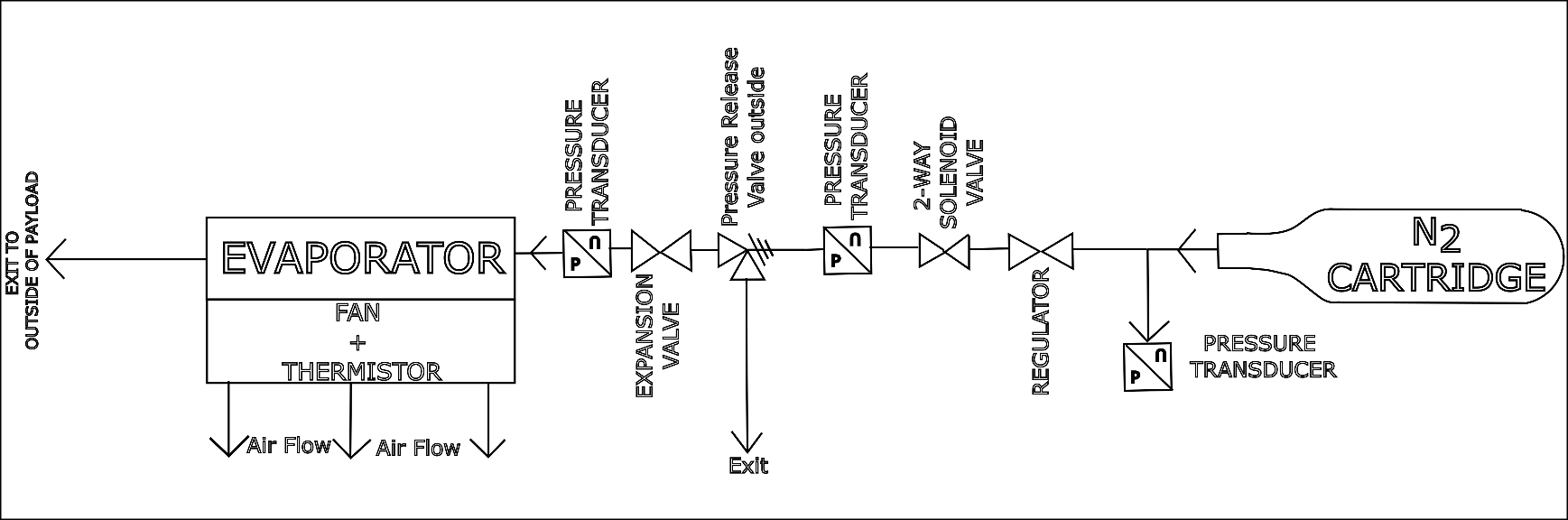
The team proposed a sealed, insulated 3U CubeSat with its own open-cycle refrigeration system:
- Refrigerant. Nitrogen from a disposable 18 g cartridge of the kind used for drinks. It is inert, safe, cheap and easy to buy. A regulator and a safety relief valve keep the line below its maximum working pressure.
- Release. A normally closed solenoid valve holds the gas until the onboard Arduino switches a 12 V relay to open it.
- Metering. An electronic expansion valve controls how much nitrogen reaches the evaporator. It compares the measured superheat and line pressure with their targets and takes the more closed of the two settings, so liquid never floods the evaporator.
- Cooling. A 12 V fan blows the payload air across the evaporator, with thermistors measuring the temperature.
- Venting. The spent gas exits through a line to a port on the nose cone, placed so it vents cleanly without building pressure inside the rocket.
Constraints and risks
Safe operation depends on accurate temperature and pressure readings for the expansion valve control. The team’s risk assessment covered a sudden pressure release at the tank or valve, gas leaks at fittings and the evaporator, loss of cooling from an electronics failure, and ice blocking the gas line.
Budget
The proposed parts list, including the cartridge, copper line, fittings, three pressure transducers, solenoid valve, evaporator, fan, microcontroller, insulation and an aluminium frame, came to about $800.
Team
A seven-person team project for the Society of Hispanic Professional Engineers (SHPE) at the University of Central Florida.