Case study · Jan – Apr 2025
Low-Cost Upper‑Limb Prosthetic
A low-cost, body-powered prosthetic arm for amputees in Nepal, where few people who lose a limb can get or afford a prosthesis. Our team designed it around locally available PVC and HDPE so it can be made, fitted and repaired close to home, then modelled and analysed it in Autodesk Inventor.
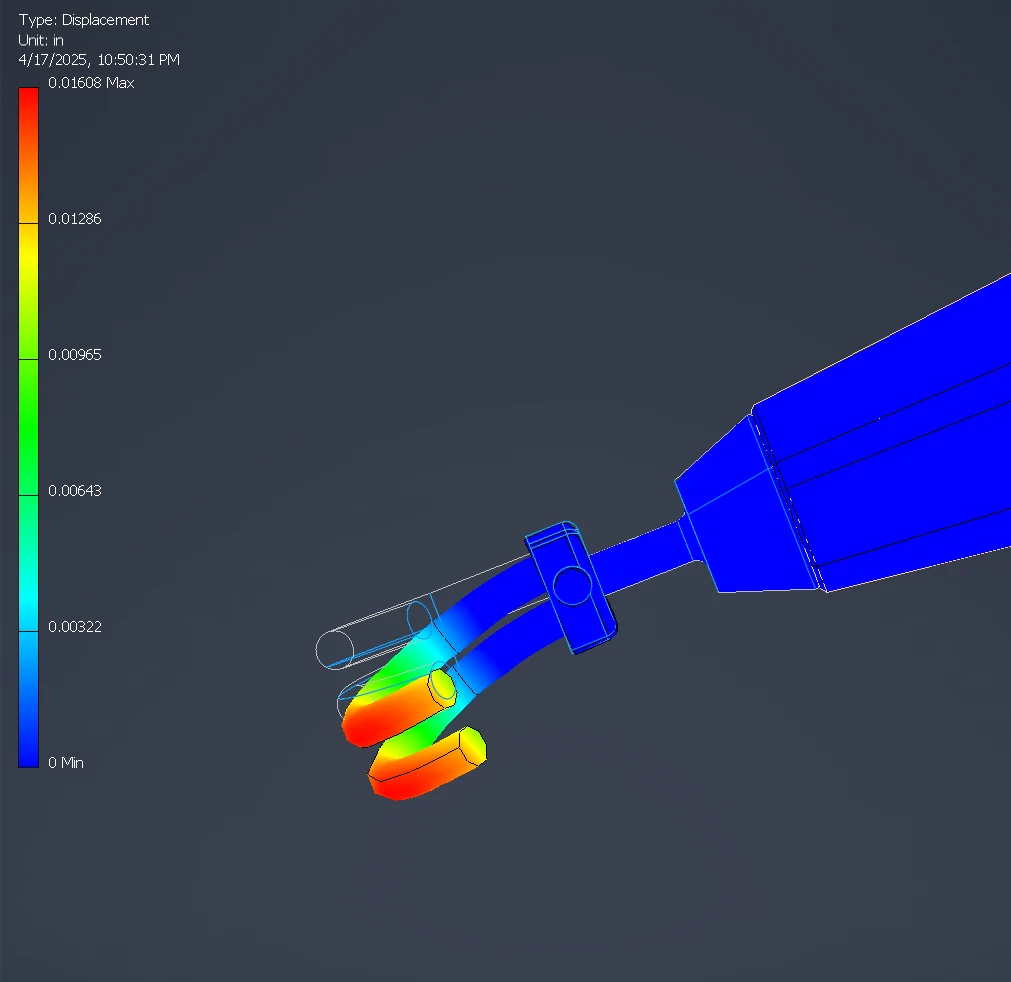
- Maximum displacement, at the hook tipsSimulation result
- 0.016 in
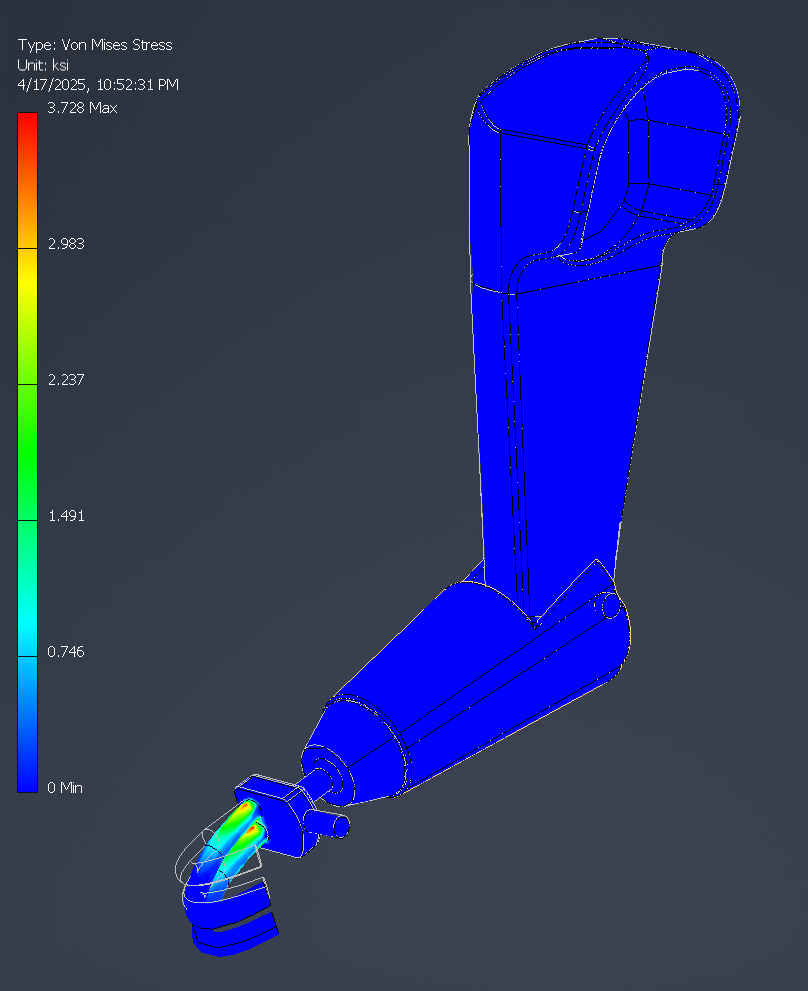
- Peak von Mises stress, concentrated in the hookSimulation result
- 3.73 ksi
Objective
Prosthetic arms often cost thousands of dollars and need professional fitting, which puts them out of reach for most amputees in Nepal, especially in rural areas far from rehabilitation centres. The goal was a functional, affordable arm that could be made, fitted and repaired locally.
Design approach
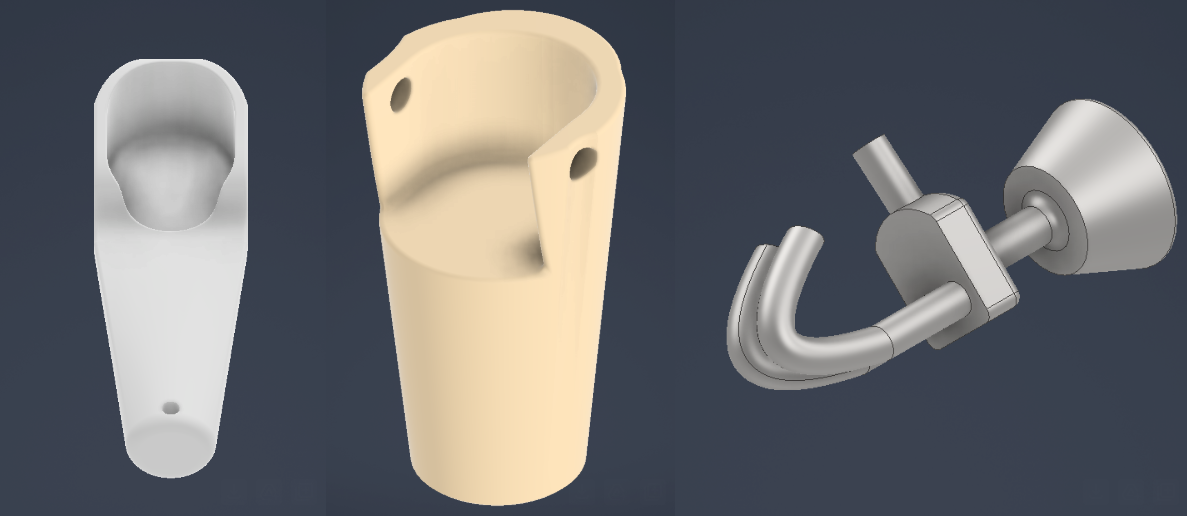
The arm is body-powered. A shoulder harness and control cable let the user open and close the hook with shoulder and chest movement, so there are no electronics, motors or batteries to fail or replace. We modelled the arm in Autodesk Inventor, with a lightweight frame that follows the arm’s natural movement at the elbow and the hook, for everyday tasks like holding utensils, a cup or a bag.
Materials
Every material was chosen because it is common in Nepal:
- PVC for the upper arm, which a technician can heat and shape from pipe to fit each user.
- High-density polyethylene for the forearm.
- Canvas or nylon webbing for a figure-8 shoulder harness, with locally available buckles and straps.
Constraints
- Cost: under $20 per device, with a hard limit of $50.
- Simplicity: few moving parts, so there are fewer ways to fail.
- Fit: one design adaptable to different limb sizes and lengths.
- Repair: it can be taken apart and reassembled with basic tools, so no glued or fused parts.
- Climate: it has to cope with cold, sun, dust and monsoon humidity.
Analysis
We ran displacement and von Mises stress simulations on the full arm in Autodesk Inventor. Stress stays near zero through the upper arm and forearm and concentrates in the hook, which peaks at 3.73 ksi. The hook tips deflect at most 0.016 in. These are simulation results; the design was not built or physically tested as part of the project.
Team
A three-person team project for the Fundamentals of Rehabilitation Engineering course at the University of Central Florida, from January to April 2025.